
The Real Story of Nighthawks: The Painting Where Nothing Happens… and Everything Happens | iCanvas
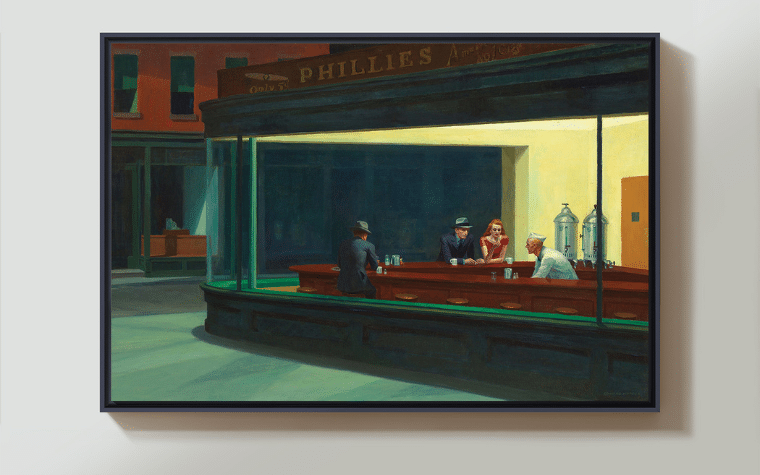
Nighthawks is the most famous painting of people doing absolutely nothing. No drama. No action. No story. And yet for over 80 years, people haven’t been able to stop staring; or stop trying to figure out what’s really going on inside that diner.
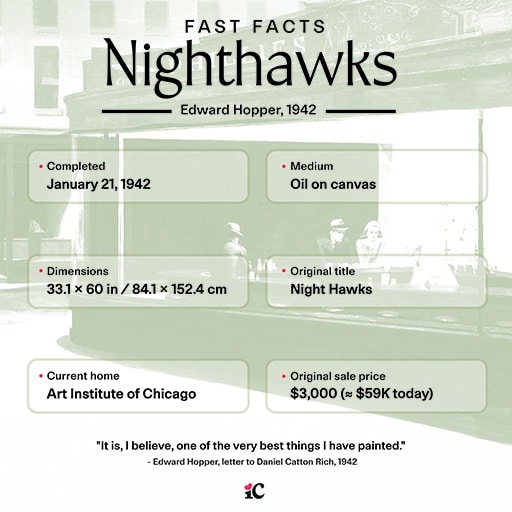
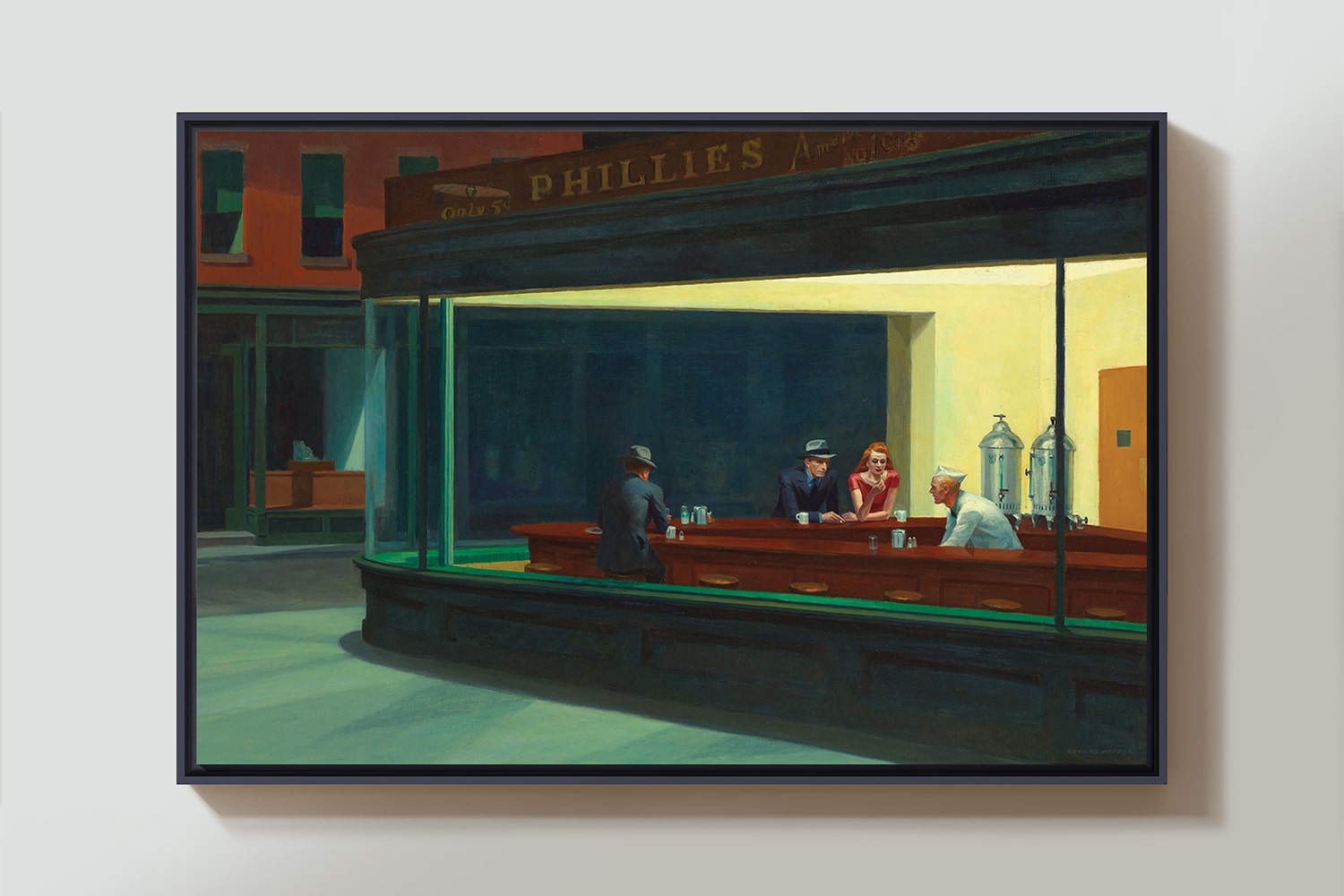
Edward Hopper completed Nighthawks on January 21, 1942, an oil on canvas measuring roughly 33 × 60 inches. Within months, the Art Institute of Chicago purchased it for $3,000 (about $59,000 today). It became one of the most recognized paintings in American art. It’s been parodied by Banksy, The Simpsons, and dozens of others. Ridley Scott waved a reproduction on the set of Blade Runner to set the mood for his crew.
And here’s what makes it even more interesting: when asked about the loneliness and emptiness people see in the painting, Hopper said he “didn’t see it as particularly lonely.”
So what exactly was he painting?
Table of Contents
TL;DR: The Real Story of Nighthawks
There’s more to Nighthawks than a late-night diner; it was shaped by WWII, Hemingway, film noir, and an obsessive creative process involving 19+ preparatory sketches. The painting’s power comes from what Hopper didn’t include: a story, an entrance, or a clear meaning. That ambiguity is exactly why it still resonates.
Nighthawks: A Quick Timeline
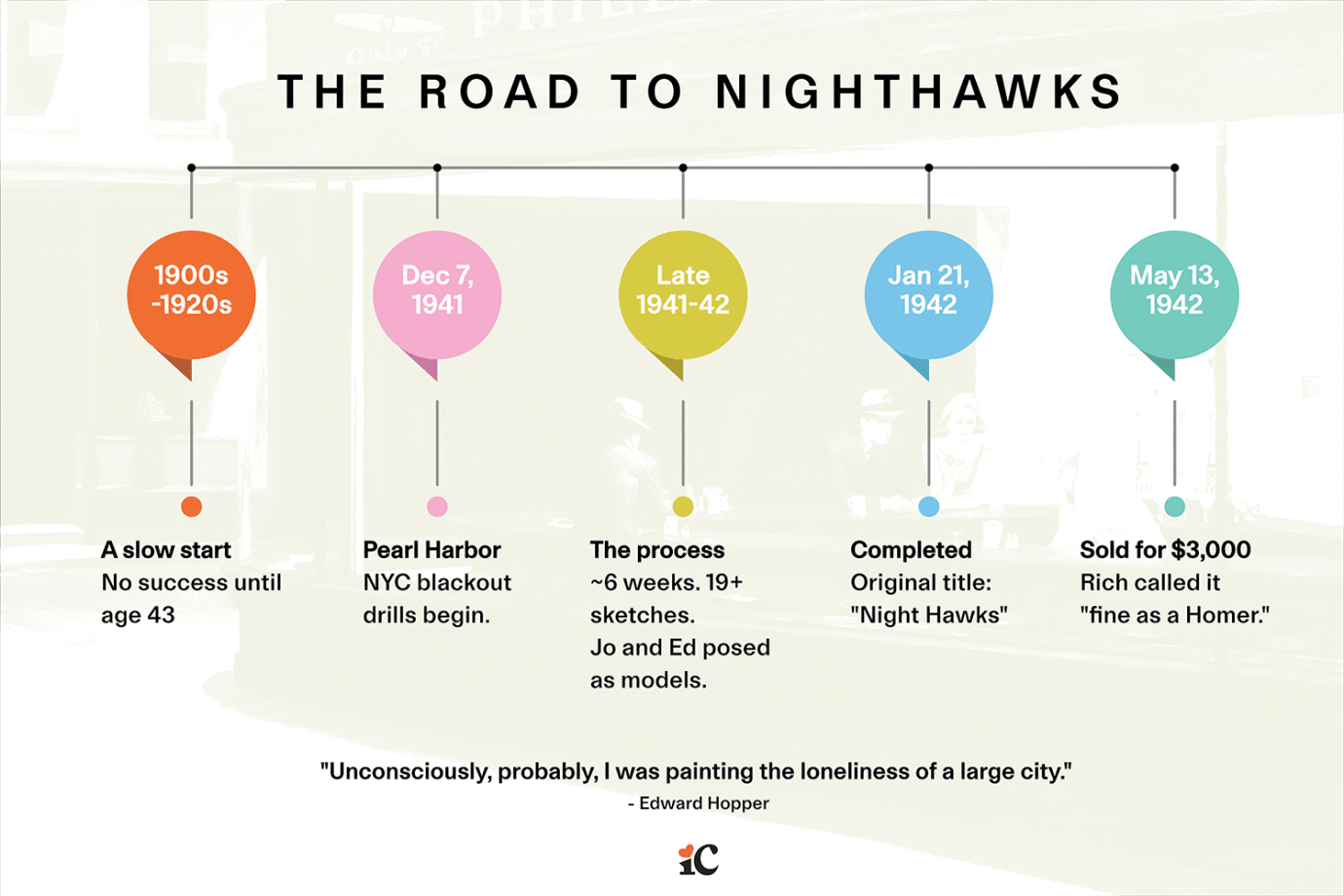
Before we get into the deeper meanings and hidden details, it helps to know the basic arc that led to Nighthawks. Like the painting itself, the backstory is deceptively simple, but once you know the timeline, the whole thing hits differently.
- Hopper’s early career (1900s–1920s): a long wait. Hopper trained under Robert Henri at the New York School of Art, but spent years grinding through commercial illustration work he openly hated. He didn’t achieve his first major artistic success until he was 43 years old.
- Pearl Harbor (December 7, 1941): the world shifts. The U.S. enters World War II. New York City goes into blackout drills almost immediately with dimmed streetlights, fear of air raids, a city literally darkened by crisis. This is the world Hopper is working in.
- The painting process (late 1941–January 1942): nothing left to chance. Edward and his wife Josephine (Jo) kept a meticulous joint journal throughout their marriage. Jo recorded that he posed for both male figures using a mirror, and she posed for the woman. He worked roughly six weeks on the painting, producing at least 19 preparatory sketches in chalk and charcoal.
- Completion: January 21, 1942. The date was recorded in Hopper’s own handwriting in their journal. The original title: Night Hawks – two words.
- The sale (May 13, 1942): instant recognition. Hopper displayed the painting at Rehn’s Gallery, his usual venue. Daniel Catton Rich, director of the Art Institute of Chicago, saw it and called it “fine as a Homer.” Jo had pushed for Rich to visit the gallery, and it paid off. The painting was purchased for $3,000 and has remained at the Art Institute ever since.
After finishing it, Hopper wrote to Rich: “It is, I believe, one of the very best things I have painted. I seem to have come nearer to saying what I want to say in my work, this past winter, than I ever have before.”
He wasn’t wrong.
A Painting Born in Darkness: Pearl Harbor and the Blackout
Here’s a detail most people miss: Nighthawks was completed less than seven weeks after the bombing of Pearl Harbor.
That timing isn’t incidental. In the weeks following December 7, 1941, New York City was gripped by fear and uncertainty. Blackout drills became routine; streetlights dimmed, public spaces went dark, and New Yorkers braced for the possibility that they could be the next target. Hopper walked the city during this time. The dark, empty streets outside the diner aren’t just a stylistic choice, they map directly to what wartime New York actually looked like.
And Hopper apparently wasn’t fazed. Jo wrote in her diary: “Ed refuses to take any interest in the very likely prospect of being bombed.” While the city went dark, his studio lights at 3 Washington Square stayed on.
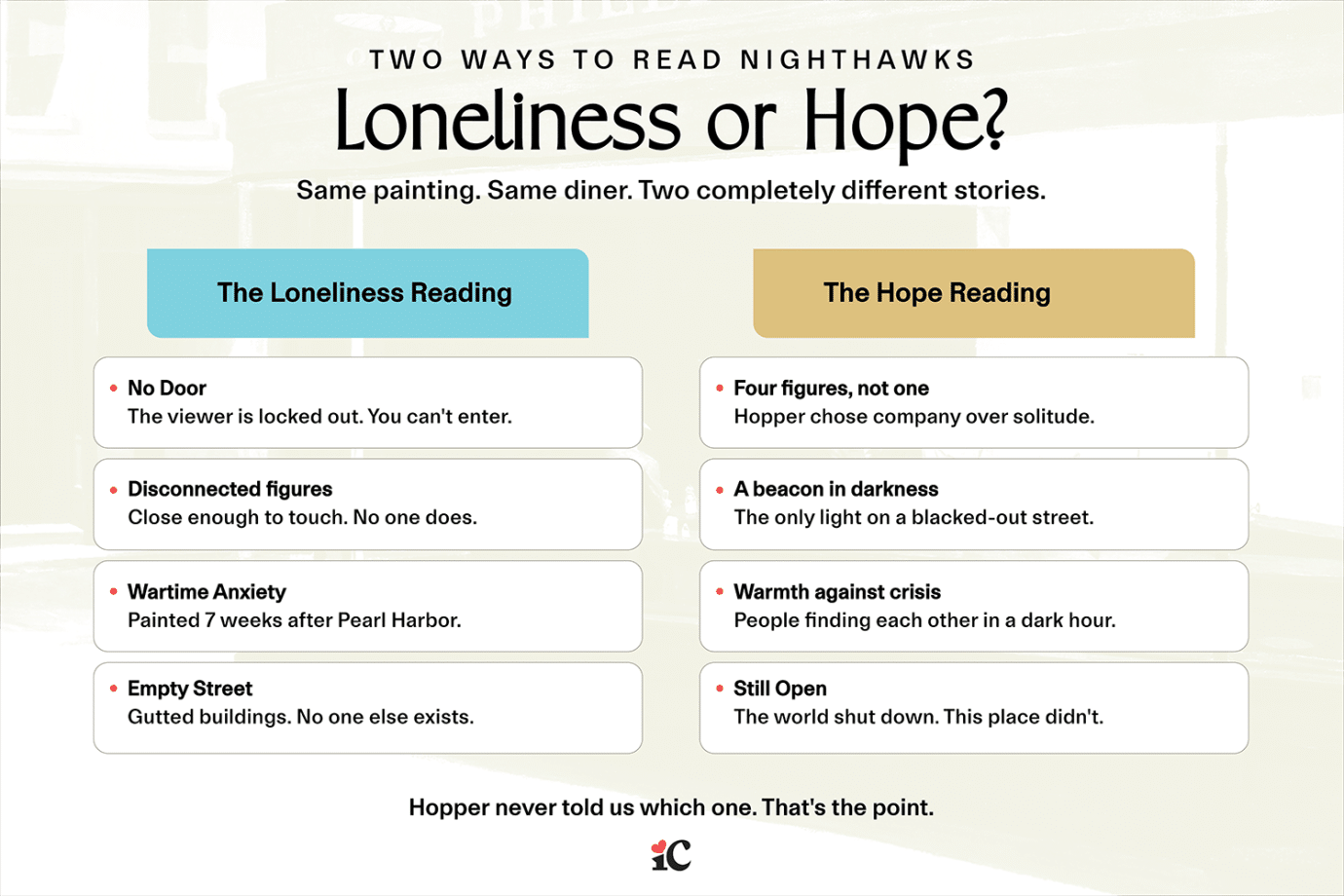
For decades, the default reading of Nighthawks has centered on loneliness and alienation. And that reading isn’t wrong. Hopper himself admitted that “unconsciously, probably, I was painting the loneliness of a large city.” But there’s another way to look at it.
Art Institute of Chicago curator Sarah Kelly Oehler offers a reframe that’s worth sitting with: what if the diner isn’t a symbol of disconnection, but a beacon of light against a city darkened by crisis? Hopper deliberately included four figures, not a lone figure, as in so many of his other paintings. Maybe the point isn’t that they’re isolated. Maybe the point is that they’re there, together, at 2 a.m. in the middle of a war.
This dual reading, loneliness or hope, is exactly what gives the painting its staying power. Hopper never told us which one he meant. That’s the point.
What You’re Actually Looking At: A Visual Breakdown
Nighthawks looks simple at first glance. A diner, some people, a dark street. But every detail in this painting was obsessively planned, and once you know what to look for, you can’t unsee it.
1. No Door
This is one of the most discussed compositional choices in American art. There’s no visible entrance to the diner. The viewer is literally locked out; you can observe, but you can’t participate. Whether that feels like exclusion or protection depends entirely on how you read the painting.
2. The Light
Fluorescent lighting was still relatively new in the early 1940s, and Nighthawks was Hopper’s most ambitious rendering of artificial light. The greenish glow would have felt modern and slightly alien to contemporary viewers. Multiple light sources inside the diner create overlapping shadows and subtle reflections on the counter, details that wouldn’t exist in daylight.
3. The Almost Touch
The couple sitting together, modeled by Edward and Jo themselves, are close enough that their hands nearly meet. But they don’t connect. He’s absorbed in his cigarette; she’s gazing at something in her hand. It’s one of the painting’s most quietly devastating details: physical proximity without emotional connection.
4. The Turned Back
The lone man sits with his back to us, widely believed to be a self-portrait based on resemblance to Hopper’s other depictions of himself. Jo’s journal entry is almost uncomfortably specific: “Man night hawk (beak) in dark suit, steel grey hat, black band, blue shirt (clean) holding cigarette.” That description may have inspired the painting’s title itself – a literal night hawk, beak and all.
5. The Server
Jo described him as a “very good looking blond boy in white (coat, cap) inside counter.” He’s the only figure actively doing something, bent forward with quiet attentiveness. But even he isn’t connecting with anyone. He’s performing a function, not building a relationship.
6. The Empty Street
No pedestrians, no cars, no debris. The building across the street looks gutted – shelves empty, lights off. The Phillies cigar sign on the diner is a small but telling detail: Phillies were cheap, common cigars sold at gas stations and grocery stores. This isn’t an upscale spot. It’s the kind of place anyone might end up at 2 a.m.
None of this was accidental. At least 19 preparatory sketches survive, and there were probably more. Hopper tested the lone man’s posture over and over – the tilt of his head, the press of his body against the counter. He drew exclusively in black-and-white chalk during the prep phase, making color notations separately. His final paintings often diverged from the sketches; he worked on instinct once he hit the canvas.
The Influences Behind Nighthawks
Nighthawks didn’t come out of nowhere. Three threads run through the painting’s DNA and they help explain why it feels the way it does.
Ernest Hemingway
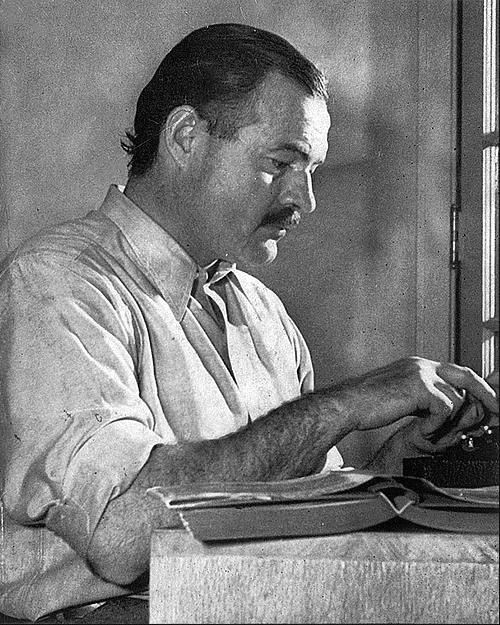
Hopper was a devoted fan. He wrote a fan letter to Scribner’s after reading “The Killers” (1927), a short story that takes place mostly at a diner counter, saturated with the feeling that something violent is about to happen but never does. Hopper biographer Gail Levin identifies it as a direct influence.
Hemingway’s “A Clean, Well-Lighted Place” (1933) also resonates deeply: a late-night café as the last refuge against existential despair. As Levin put it, Hopper’s paintings share that same quality – “the sense of something about to happen, and it never does.”
Vincent van Gogh’s Café Terrace at Night, 1888
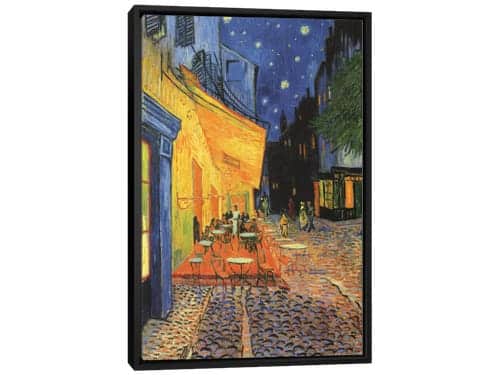
Levin also speculates that Hopper may have been influenced by Van Gogh’s Café Terrace at Night, which was showing at a gallery in New York in January 1942, the exact month Hopper finished Nighthawks. The painting had twice been exhibited alongside Hopper’s own work, so he almost certainly saw it.
The shared DNA is hard to miss: a brightly lit café interior glowing against a dark night, warmth spilling out into a void. Van Gogh painted what the night felt like from the outside looking in. Hopper did the same thing, just 54 years later, in a very different city.
(Explore Van Gogh prints on iCanvas or Read our deep dive: Why Van Gogh Painted The Starry Night in an Asylum)
Film Noir
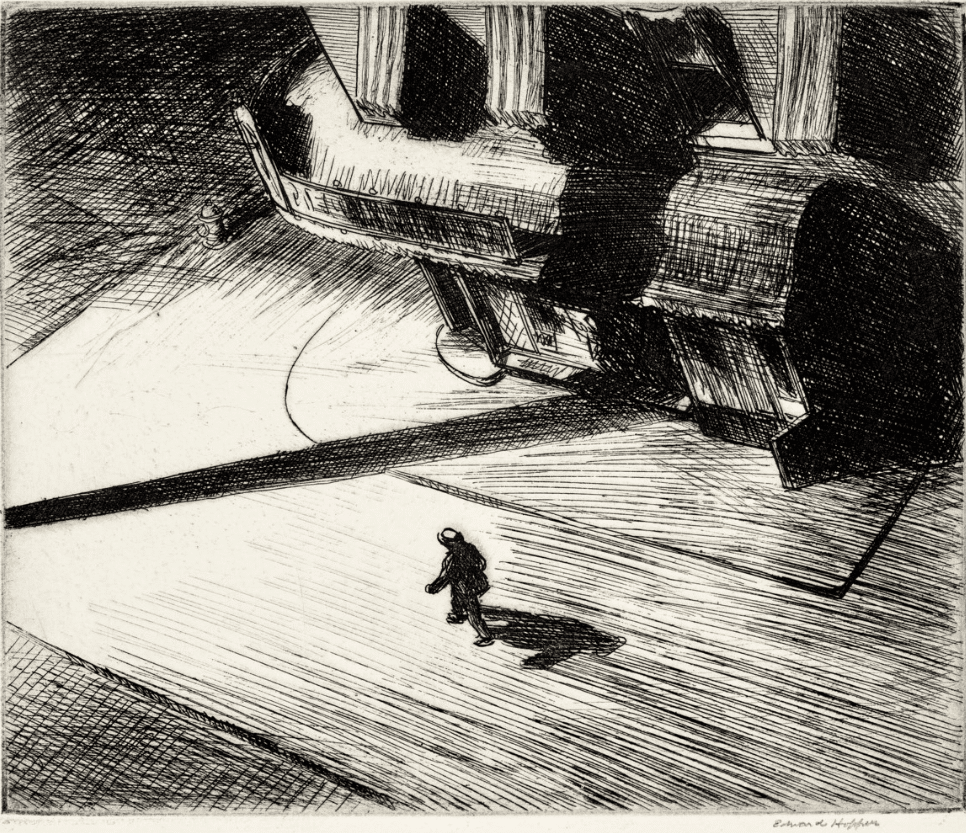
Hopper was an avid moviegoer who admitted to going on multi-week “movie binges” when he wasn’t in the mood to paint. The Art Institute connects his aesthetic directly to early film noir: the dramatic use of angles, shadows, patterns of light, and scenes framed through windows and doorways. His 1921 etching Night Shadows (above) is proof the cinematic instinct was there long before Nighthawks – a bird’s-eye view of a lone figure on a dark street, hard shadows cutting across the pavement. That same DNA runs through the diner painting: the fedoras, the woman in red, the deserted street, the feeling that something could happen at any moment.
Ridley Scott saw it too. He famously cited Nighthawks as the key visual reference for Blade Runner‘s nocturnal mood. And when The Killers was adapted into a film in 1946, the filmmakers literally recreated the Nighthawks diner on screen.
The Real Story of Nighthawks: The Diner That Never Existed
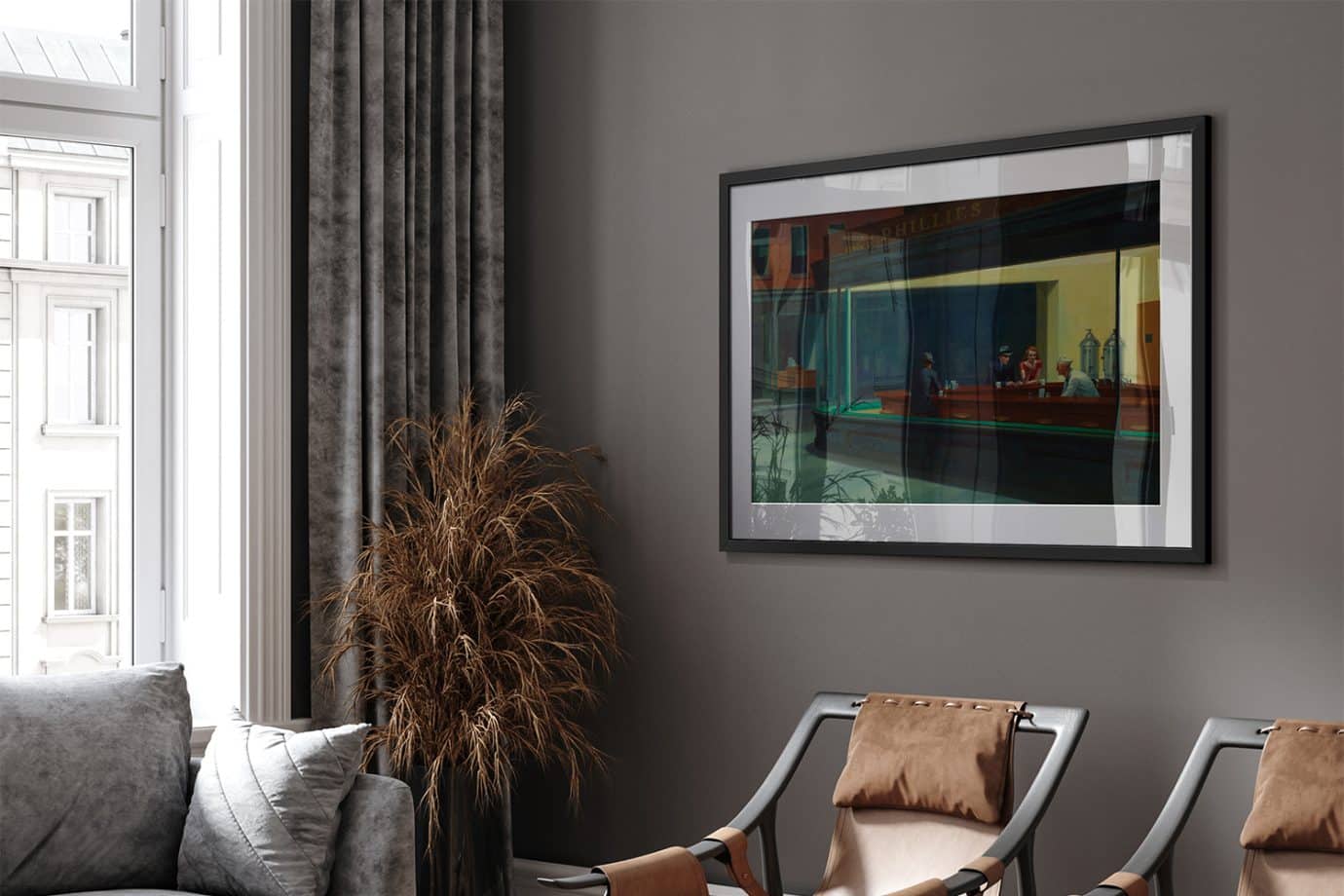
One of the most enduring obsessions around Nighthawks is the hunt for the real diner. People have been searching for it for decades. They haven’t found it and they probably never will.
Hopper said the painting was “suggested by a restaurant on New York’s Greenwich Avenue where two streets meet” and that he “simplified the scene a great deal and made the restaurant bigger.” That’s it. That’s all he gave us.
The spot most commonly cited as the original location is Mulry Square, at the intersection of Seventh Avenue South, Greenwich Avenue, and West 11th Street, about seven blocks from Hopper’s studio on Washington Square. But there’s a problem: a gas station occupied that lot from the 1930s to the 1970s. It can’t be the place.
According to Gail Levin’s biography, Hopper sketched the coffee urns at the Dixie Kitchen on 5th Avenue, a cheap cafeteria he and Jo frequented. The counter, the stools, the figures, all pulled from different places and reassembled into something that feels real but never was.
There’s even a theory that the true visual source isn’t a diner at all, but a scene from the 1940 B-movie Stranger on the Third Floor; the angles, the curved glass window, and the width of the sidewalk are nearly identical. Hopper was a self-described movie binge-watcher. It’s not a stretch.
But the composite nature of the diner is the whole point. It’s not one place. It’s every late-night diner you’ve ever sat in at 2 a.m., half-awake, half-thinking, not really talking to anyone. That’s why the painting works. You’ve been there.
Keep Exploring: Bring the Diner Home
- Shop Nighthawks on iCanvas – The most iconic diner scene in art history, on your wall.
- Explore More Edward Hopper Prints – From Soir Bleu to The Cat Boat, discover more of Hopper’s quiet intensity.
FAQ: Edward Hopper & Nighthawks
▼View the Questions
What is the meaning behind Nighthawks?
There’s no single answer — and that’s intentional. Nighthawks has been read as an expression of wartime isolation, urban loneliness, a beacon of hope in darkness, and a meditation on existential solitude. Hopper never assigned a fixed meaning. The painting’s ambiguity is what allows every generation to project their own experience onto it.
Did Edward Hopper paint Nighthawks about loneliness?
He pushed back on the idea, saying he “didn’t see it as particularly lonely.” But he also admitted that “unconsciously, probably, I was painting the loneliness of a large city.” Both things can be true, and that tension is part of what makes the painting so enduring.
Where is the Nighthawks diner?
Hopper said it was based on a restaurant “on Greenwich Avenue where two streets meet” in New York City, but decades of searching have never identified a single matching location. The diner is most likely a composite of several real places — including details sourced from different cafés, diners, and even a movie.
Who are the people in Nighthawks?
Hopper posed for both male figures using a mirror, and his wife Jo modeled for the woman. Jo’s journal describes the figures in vivid detail, including the man she called a “night hawk (beak)” — a description that may have directly inspired the painting’s title.
Where is Nighthawks today?
It’s in the permanent collection of the Art Institute of Chicago, where it has been since its purchase in May 1942 for $3,000. It remains one of the museum’s most visited works.
Was Nighthawks inspired by Hemingway?
Very likely. Hopper admired Ernest Hemingway’s short story “The Killers” (1927), which takes place largely at a diner counter and carries the same feeling of suspended tension. Hopper biographer Gail Levin identifies it as a direct influence on the painting.
Why is there no door in Nighthawks?
No entrance is visible anywhere in the composition, which forces the viewer into a voyeuristic position; you can look in, but you can’t enter. It’s one of the painting’s most powerful and most discussed compositional choices, and it plays directly into both the loneliness and hope readings of the work.