
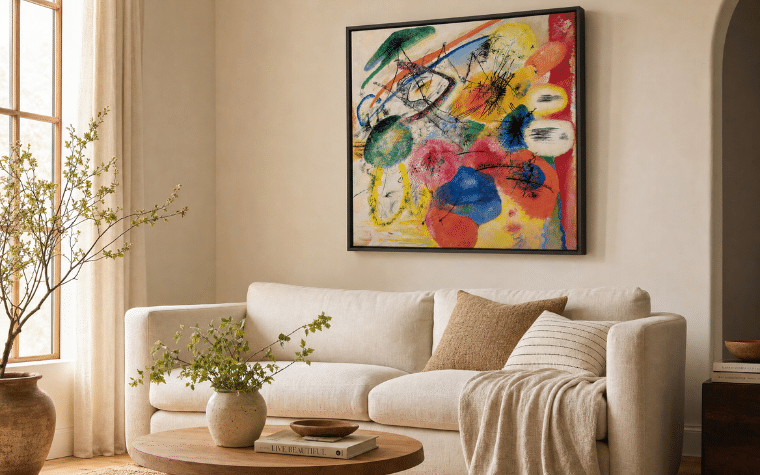
What Does a Painting Sound Like? Kandinsky’s Color-Sound Synesthesia | iCanvas
When Wassily Kandinsky looked at yellow, he heard a trumpet. When he saw deep blue, a cello played. Violet arrived with the low register of a bassoon. He wasn’t being poetic, he had chromesthesia, a form of synesthesia where sound and color are neurologically connected. And that cross-wired brain didn’t just change how he painted. It gave us abstract art.
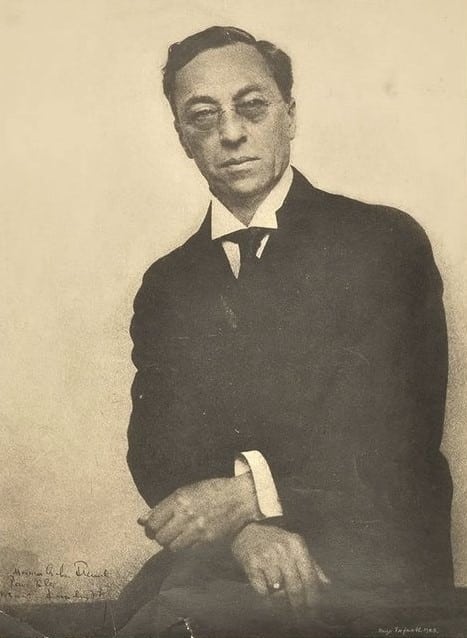
Kandinsky’s color-sound synesthesia is one of the most fascinating and least talked about origin stories in art history. It explains why his paintings feel so different from everything that came before them, why he organized his works like musical scores, and why standing in front of one of his canvases tends to produce a physical response even if you can’t quite explain why. It also turns out to be surprisingly relevant right now: a new generation of synesthete artists are doing exactly what Kandinsky did: painting music in real time and building enormous audiences doing it on TikTok.
Here’s everything you need to know about the condition that changed art history, the theory behind it, and the artists carrying it forward today.
Table of Contents
TL;DR: Wassily Kandinsky’s Color-Sound Synesthesia
Wassily Kandinsky had chromesthesia, a neurological condition where he saw colors when he heard music. He built his entire theory of abstract art around it, mapping specific colors to specific instruments in his 1911 book Concerning the Spiritual in Art. That framework influenced a century of modern art, and today a new wave of synesthete painters and creators are making the same phenomenon go viral.
The Night That Changed Everything
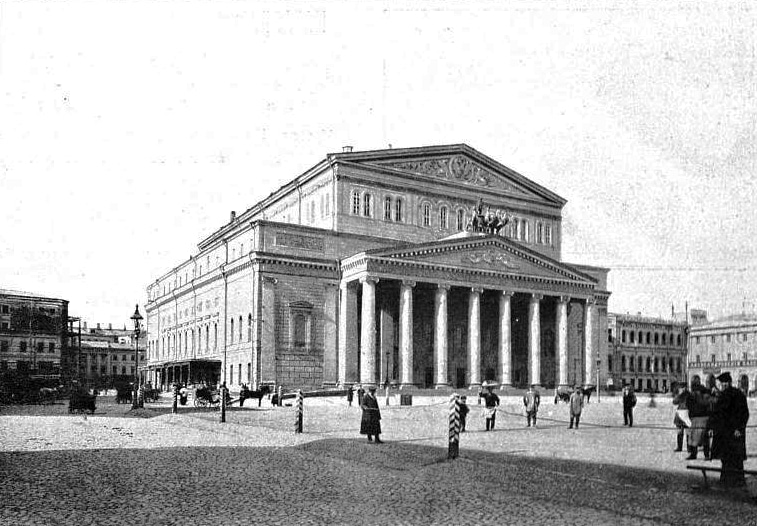
In 1896, Wassily Kandinsky was a 30-year-old law professor in Moscow with a promising academic career and a growing restlessness he couldn’t quite name. That year, he attended a performance of Wagner’s opera Lohengrin at the Bolshoi Theatre.
He didn’t just hear the music. He saw it.
Colors surged through his mind as the orchestra played. Lines sketched themselves in front of him. The experience wasn’t metaphorical, it was neurological. As Art UK documents in their study of music and abstract painting, Kandinsky later described experiencing his entire color palette during the performance, the violins and wind instruments each arriving as something visible as well as audible. In that moment, he understood that painting, like music, didn’t need to represent anything to move someone. It just needed to feel true.
The Guggenheim Museum’s teaching materials on Kandinsky describe this as the pivotal turning point: a trained lawyer who had already begun questioning his career path now had a framework for everything he wanted painting to become. Two years earlier he had walked away from a law professorship to study art in Munich. The Wagner evening confirmed it. Color and shape alone could carry the same emotional weight as a symphony.
As Beyond Every Art notes in their analysis of synesthesia’s influence on his work, this experience didn’t just inspire Kandinsky, it gave him permission to pursue the most radical idea in Western painting at the time: that abstraction wasn’t a failure to depict reality. It was a higher form of reality altogether.
What Is Chromesthesia? (Color-Sound Synesthesia)
Kandinsky had a specific form of synesthesia called chromesthesia, where sound automatically triggers a visual color response. This isn’t a creative exercise or an artistic choice; the colors arrive before conscious thought does.
The Art Story’s overview of synesthesia in art notes that roughly 2–4% of people experience some form of synesthesia, with chromesthesia among the most common variants. For those who have it, the associations are consistent and involuntary. The same sound reliably produces the same color, every time, across years and decades. The Synesthesia Test’s profile of Kandinsky points out that this consistency was key to his confidence in building an entire artistic theory around it. They were repeatable facts about how his sensory system worked.
Kandinsky’s color-sound synesthesia made color a deeply personal language. Not a decorative choice or a compositional tool, but a sensory fact.
His Color-Sound Chart
In 1911, Kandinsky published Concerning the Spiritual in Art, considered the first theoretical foundation for abstract painting and one of the most influential art manifestos ever written. Interlude’s deep dive into his color-music framework breaks down how he mapped his chromesthetic experience with striking precision: every color had a sound, every sound had a color. The associations weren’t vague, they were instrument-specific.
| Color | Sound |
| Light blue | Flute |
| Dark blue | Cello and contrabass |
| Deepest blue | Organ |
| Yellow | High trumpet |
| Red | Violin |
| Orange | Alto voice, church bells |
| Violet | English horn, bassoon |
| Green | Violin – middle register, placid |
| White | A harmony of silence – full of possibility |
| Black | Closure; an extinguished silence |
He also described colors in terms of movement and temperament. As The Marginalian’s essay on the spiritual element in his work explores, Kandinsky saw yellow as having no depth, striking the viewer the way a trumpet strikes the ear: forward, aggressive, insistent. Blue pulls inward, withdrawing into itself like a cello note held and then released. Green is inert, satisfied to be still. “The sound of colors is so definite,” he wrote, “that it would be hard to find anyone who would express bright yellow with bass notes, or dark lake with the treble.”
The Paintings as Scores
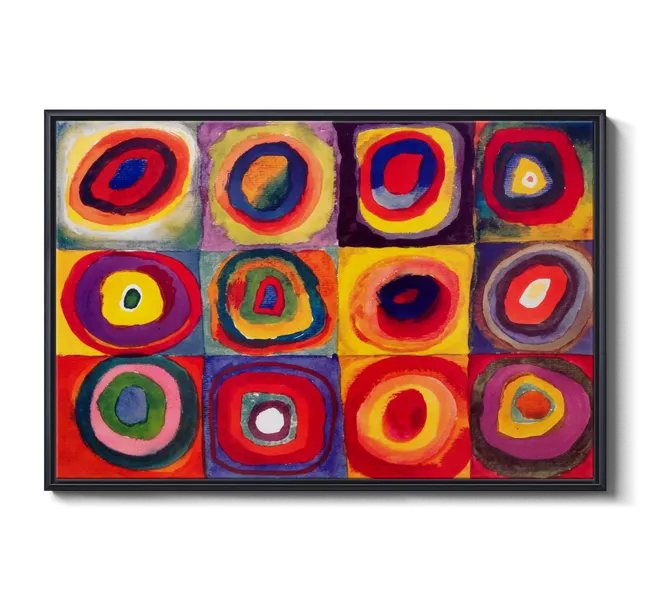
With this framework in place, Kandinsky’s color-sound synesthesia paintings read completely differently. The Denver Art Museum’s feature on Kandinsky’s color symphony describes how his works were organized into three series: Impressions, Improvisations, and Compositions. They were structured exactly the way music is: by spontaneity, by intuition, and by fully worked-out formal intention.
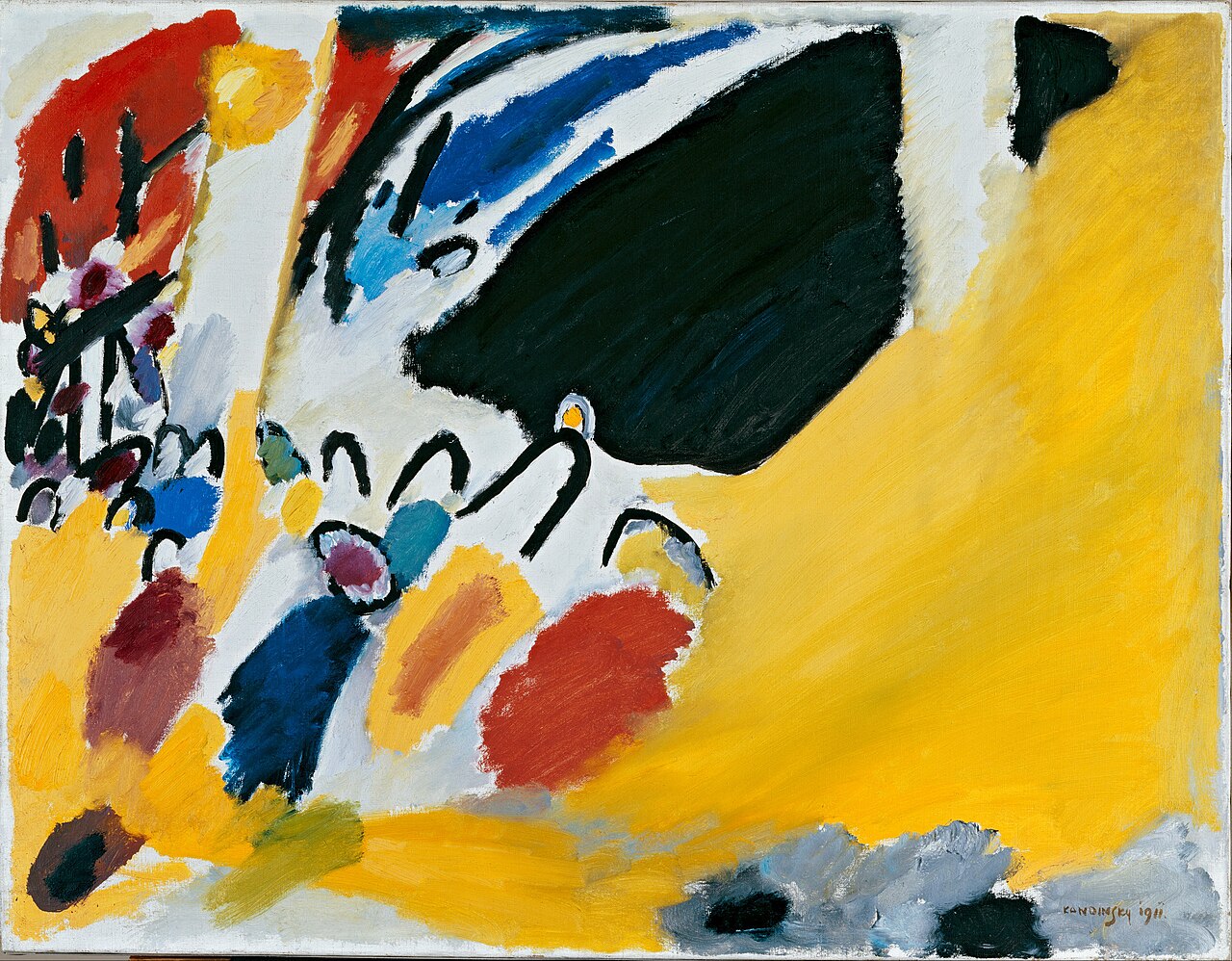
Impression III (Concert), painted in 1911 directly after attending a performance by avant-garde composer Arnold Schoenberg, is perhaps the most literal example. The canvas is dominated by a sweep of black and yellow: a trumpet blast, rendered visible. As Art History 101’s analysis of Kandinsky and synesthesia explains, Schoenberg was abandoning tonality at the same moment Kandinsky was abandoning the figure; both believed the underlying emotional structure of art mattered more than the conventional forms containing it.
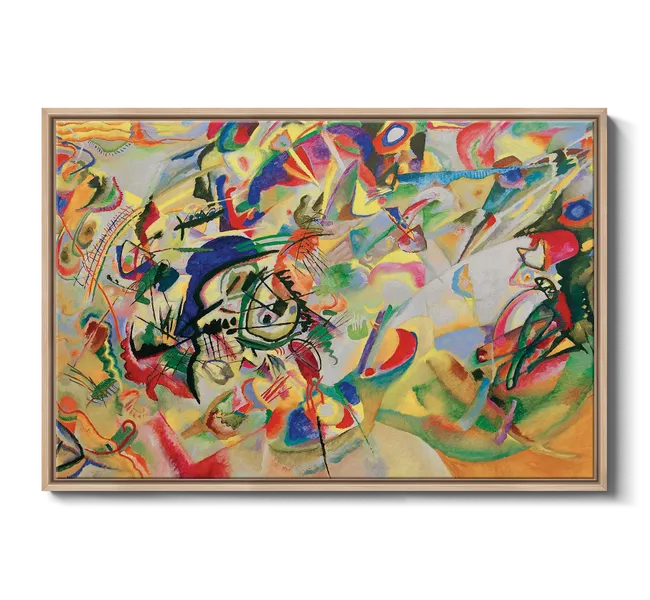
Composition VII (1913) went further – a canvas of interlocking forms and dissonant color relationships, developed over weeks of preparatory studies. It’s often described as the visual equivalent of a symphony: multiple movements, recurring color motifs, moments of chaos held together by formal architecture.
Kandinsky also took the concept beyond canvas entirely. As Animato UK’s piece on his synesthesia notes, The Yellow Sound (1909) was a stage performance combining colored lighting, musical composition, and abstract movement. It was essentially a live chromesthetic experience, decades before anyone called it immersive art.
The Bauhaus and the Legacy
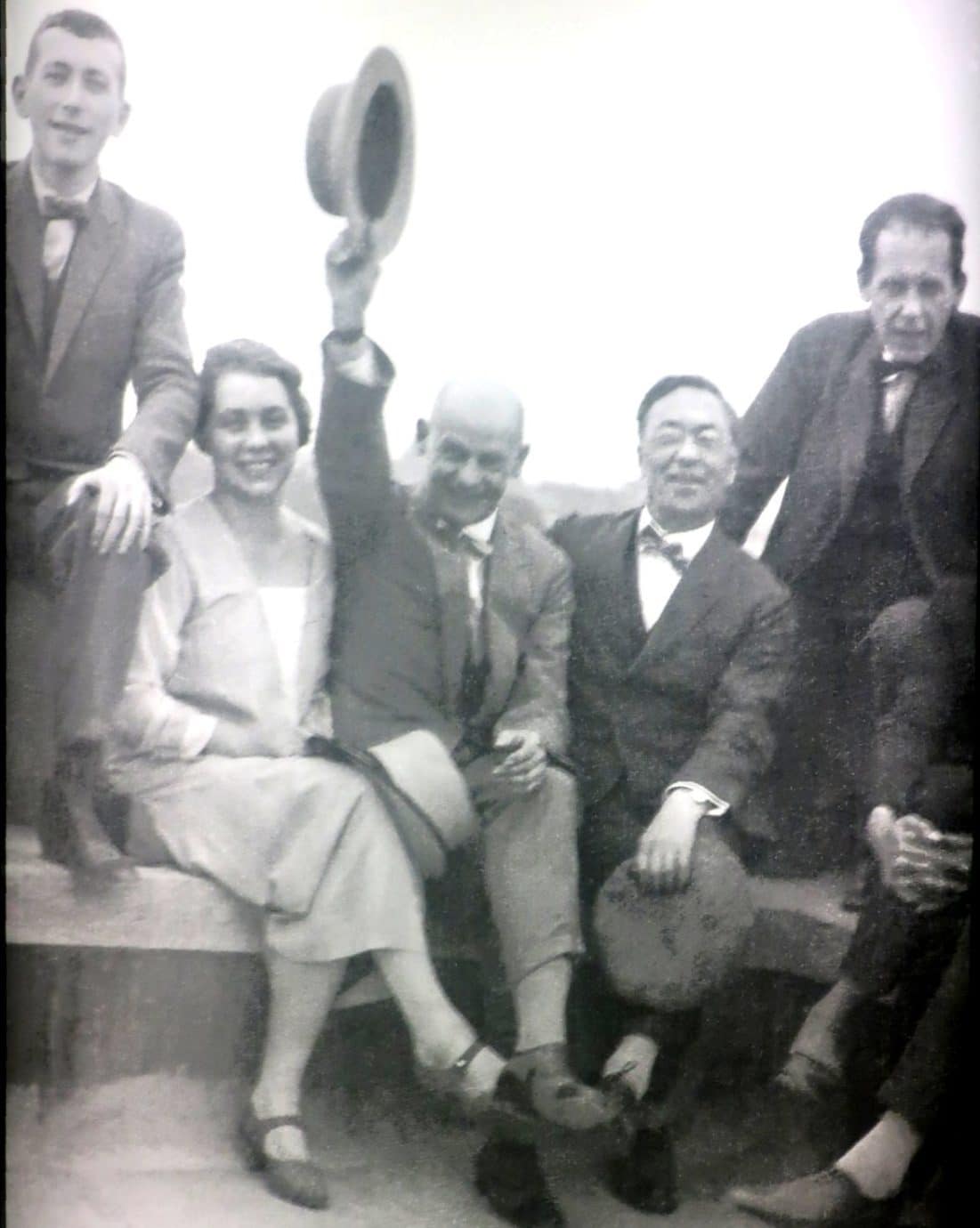
In 1922, Kandinsky joined the Bauhaus school in Dessau, Germany; his ideas stopped being personal philosophy and became formal curriculum. Art History 101 traces this shift in how he taught the Preliminary Course, where students studied color relationships, spatial tension, and the emotional weight of form. His 1926 follow-up book, Point and Line to Plane, extended the framework further. Every mark on a canvas was a sound, and the way marks related to each other was counterpoint.
For a period, the idea that painting and music shared a grammar wasn’t eccentric; it was the most serious conversation happening in Western art. The Art Story’s overview of synesthesia’s role in modern art argues that Kandinsky’s Bauhaus tenure is where his personal condition became a lasting design language. It rippled through Abstract Expressionism, Color Field painting, Op Art, and Minimalism in ways we’re still living with today.
Color-Sound Synesthesia Now: It’s All Over Your Feed
Here’s what’s worth knowing about synesthesia in 2026: it’s having a cultural moment.
A growing number of musicians have spoken openly about experiencing it. As Popdust’s roundup of iconic musicians with synesthesia documents, Billie Eilish has described designing entire album visual worlds around her synesthetic color associations. Her music videos, she’s said, are built directly from the colors she perceives in each song.
Pharrell Williams identifies musical keys by color; his group N.E.R.D. named an album Seeing Sounds. Frank Ocean titled Channel Orange after the color he experienced falling in love. We Rave You’s feature on artists who see sound adds Billy Joel to the list; the key of C is white; A minor is deep purple.
And then there’s artists on the internet.
Creators like Sarah Kraning (@sarahkraning on TikTok and Instagram) have built substantial followings by doing exactly what Kandinsky spent his career trying to explain: painting what music looks and feels like to them, live on camera. Her video painting Billie Eilish’s music through her synesthetic lens reached over 300,000 views, and she’s been featured by Guggenheim Magazine specifically as a modern-day parallel to Kandinsky.
She paints Chappell Roan, BTS, The Beatles, and more, the canvas responding in real time to whatever she’s hearing, the audience watching colors arrive that most people can’t see.
Contemporary painters Melissa McCracken (Kansas City) and Jack Coulter (Belfast) have built their entire practices around chromesthesia. Colossal’s feature on McCracken describes how she titles every abstract oil directly after the song that inspired it – Jimi Hendrix, John Lennon, Prince, with jazz appearing to her as iridescent blues, whites, and golds.
Coulter, profiled by Made in Bed and named to Forbes’ 30 Under 30 list for Art & Culture in 2021, translates the colors of Miles Davis and Dizzy Gillespie directly onto canvas, his work now held in the private collections of Paul McCartney and the Freddie Mercury Estate.
Synesthesia hasn’t changed. But our ability to witness it, share it, and understand it, that’s entirely new. Kandinsky was working in isolation, trying to explain something his contemporaries could barely conceive. These artists are doing it for millions of people, in real time, on their phones.
What It Means for How You See Color
You probably don’t have chromesthesia. But that doesn’t mean color isn’t doing something to you.
Research in color psychology has documented what Kandinsky grasped: that color affects heart rate, spatial perception, and emotional response in measurable, consistent ways. His observation that yellow is aggressive, that blue pulls inward, that green is still, these aren’t mystical claims. They’re neurological ones that science has since caught up to.
Which means when you stand in front of a Kandinsky and feel that orange pressing forward, or that violet receding, or that yellow getting a little bit loud, you’re not imagining things. He wasn’t making it up. He was just making it visible.
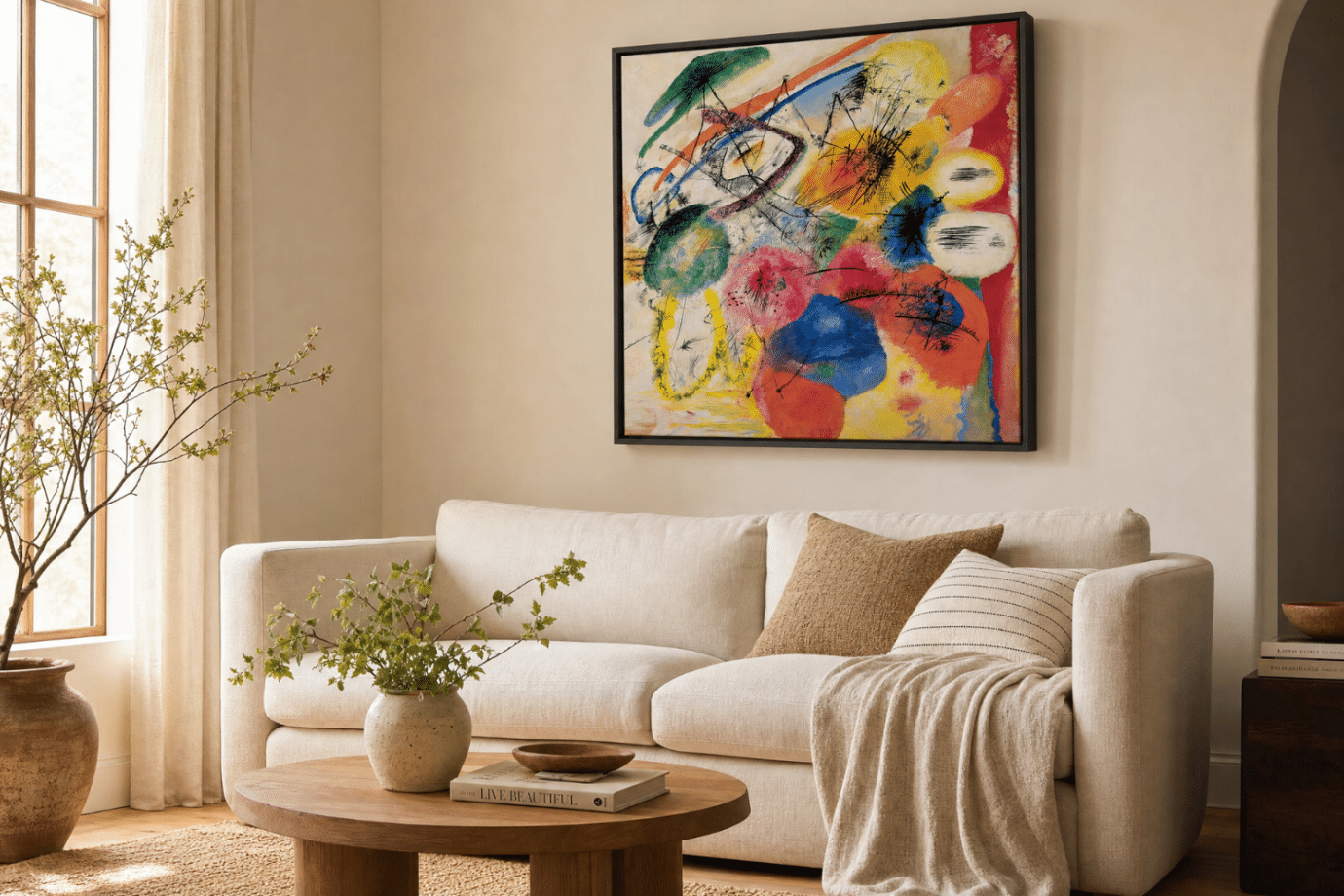
Explore Kandinsky’s full collection of prints on iCanvas, from the thunderous yellows and blacks of his early abstractions to the structured geometry of his Bauhaus period. Each one a painting. Each one, for him, a score.